
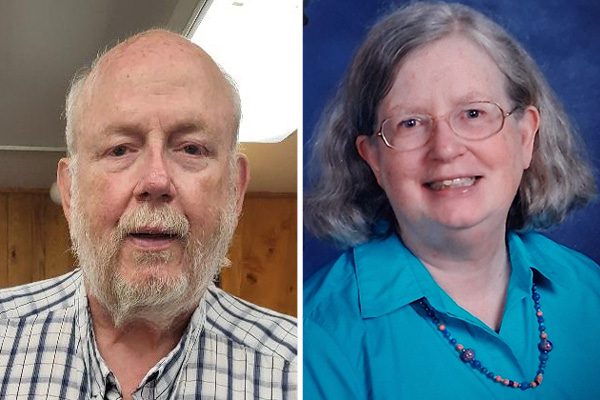
For siblings Patricia Sherlock Dillion ’71 and George Sherlock ’75, University of the Ozarks was more than a place to earn a college degree. It was a life-changing experience that helped shape their careers, build their confidence and instill a lifelong commitment to service.
More than five decades later, the brother and sister continue to show their gratitude by giving back to the University that made such a lasting impact on their lives.
Patricia, who resides in Media, Pa., and George, who lives in Howell, Mich., have been faithful supporters of their alma mater since the 1980s. Their connection to Ozarks began in an unlikely way during the summer of 1968.
Growing up in Michigan, the Sherlock siblings first heard about what was then The College of the Ozarks through their Presbyterian Church. Patricia, serving as an adult youth leader, accompanied a group of high school students, including her younger brother, George, to a summer work project where she first learned about the college.
What began as a church service trip would ultimately change the course of both siblings’ lives.
“I had been working and commuting to a local college without enthusiasm,” Patricia said. “There were large classes with no contact or help from professors. My goal of becoming a social worker seemed far away and at best I was a mediocre student. The summer of 1968 there were many youth work camps involved through the Ozark Area Ministry. An Ozarks student, Leon Anderson, was responsible for the groups and was very interested in telling us about Ozarks and what it had to offer. He encouraged me to consider transferring to Ozarks in the fall which I did.”
For Patricia, the decision to transfer proved transformational. She discovered a close-knit academic community where professors took a personal interest in their students and where opportunities for learning extended well beyond the classroom.
Patricia said transferring to Ozarks “changed my life.”
“Classes were smaller and professors were interested in our succeeding,” she said. “I learned to think critically and found classes more challenging than at the larger university. The volunteer opportunities through the Ozark Area Mission confirmed my focus on social work. The additional opportunity to work and study with international students, and contemporaries of other races and backgrounds opened my horizons.”
A few years later, George followed his older sister to Ozarks, finding the same supportive environment that had made such a difference in her life. For him, the choice between a small liberal arts college in Arkansas and a large urban university in Michigan was one he would never second-guess.
“Many students coming out of high school will thrive at any college or university large or small,” he said. “However, there are also many that would be lost in a large university and need a small liberal arts college. I was one of those kids. My options were Ozarks with a student body of 525 or Wayne State University in Detroit with 35,000 commuter students. I have never regretted my choice.”
George, who retired following a long career as a technical director at numerous colleges, credits Ozarks with helping him develop the confidence and leadership skills that would serve him throughout his professional and personal life.
While the classroom provided a strong academic foundation, it was the friendships, campus involvement and opportunities to take on leadership roles that proved especially meaningful.
“I graduated from high school in a white middle class suburb with good grades, but lacking in self-confidence,” he said. “At Ozarks, I met and became friends with students from a variety of backgrounds other than mine. Because of the size of the college, you may have some of your friends in two or even three classes during the same semester. Sometimes one of them would tell me a club they were in had a service project scheduled and invited me to help. Eventually, I would be asked to lead some of these projects. This was instrumental in my maturing into the confident person I became.”
George’s appreciation for those experiences inspired him to establish the George Sherlock Student Award in 1994. Presented annually during Honors Day, the award recognizes a student who “shows exceptional service to the University and who is active in campus life.”
Through the award, George hopes to celebrate and encourage the same spirit of involvement that helped shape his own college experience.
“I believe the ability to be active in a variety of extra-curriculars was as important as my time in class in making me the person I became,” he said. “This is only possible at a small place like Ozarks.”
For Patricia, Ozarks provided not only a sense of belonging as a first-generation college student but also the encouragement and guidance to discover a calling that would define her life’s work.
“Many of my fellow students were also first-generation college students with limited income and the college opened doors to all of us,” she said. “By the time I finished in the spring of 1971 I had come to realize that not only was I interested in a career in social work but recognized that I was being called to ministry. With the support of Ozarks staff, I applied and was accepted into both McCormick Seminary and Loyola University social work program in Chicago for the fall of 1971.”
Those dual master’s degrees launched Patricia into a professional life devoted to social work, service and ministry. Looking back, she credits Ozarks with helping her recognize her potential and discover a path she might never have pursued otherwise.
It is that same opportunity for personal discovery and transformation that continues to inspire her financial support of the University today.
“That may never have happened without the opportunities at Ozarks,” she said. “I continue to give to the Ozarks Scholarship fund because University of the Ozarks continues to be committed to students who may find their life’s direction there as I did.”
Topics: Donor Spotlights